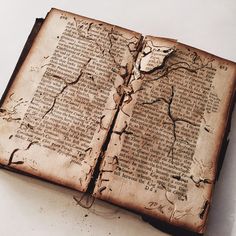
Found at Jot HQ the other day—The Private Library—an attractively bound volume of 1897 by the antiquarian A(rthur) L. Humphreys, author of How to Write a Village History, Old Decorative Maps and Charts and the Berkshire Book of Song, Rhyme and Steeple Chime.
Among the various interesting things he has to say about books in general is his section on ‘The Care of Books ‘. These observations may be listed in a number of sub-headings which could appear thus:-
1) Anecdotes by Andrew Lang.
‘…( Sir Walter ) Scott was very careful; he had a number of wooden dummies made, and, when a volume was borrowed, he put the dummy in its place on the shelf, inscribing it with the name of the borrower. He also defended his shelves with locked brazen wires. ‘ Tutus clausus ero’ ( “ I shall be safe if shut up “) , his anagram, was his motto, under a portcullis…Housemaids are seldom bibliophiles. Their favourite plan is to dust the books, and then rearrange them on fancy principles, mostly upside down. One volume of Grote will be put among French novels, another in the centre of a collection of sports, a third in the midst of modern histories…The diversity of sizes, from folio to duodecimo, makes books very difficult to arrange where room is scanty. Modern shelves in most private houses allow no room for folios, which have to lie, like fallen warriors, on their sides.’
2) Heat and dust as enemies of books.
‘Mr Poole , a very experienced American librarian…made an experiment in the upper gallery of a library, and found that—“ while the temperature of the floor was 65* Fahr., that of the upper gallery was found to be 142*. Such a temperature dries up the oil of the leather and burns out its life. Books cannot live where men cannot live.”
In London particularly dust, smoke, and soot get at books and do great damage. To have the top edges gilded is an excellent way to prevent dust getting into the leaves. Books which have roughly trimmed tops harbour dust much more readily, and it is with great difficulty removed from such…Books should not be either swung together
or beaten together. The carpet in a library should not reach the wall, or right to the cases, but should fall short so as to be removed when required to be cleaned…’ Continue reading

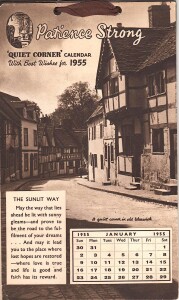 Found amongst a pile of books at Jot HQ, the pocket-sized ‘Patience Strong ‘Quiet Corner ‘calendar for 1955 with its sepia photographs of ‘ picturesque ‘ spots in England. We had almost forgotten that publishers still used sepia photographs as late as this, but then remembered the lifeless and dispiriting photographs of landscapes and empty streets in Arthur Mee’s ‘King’s England’ series of county guide books. No wonder the county guides published by Shell from 1934 were regarded as such a welcome change from these dreary volumes. Mee’s totally predictable descriptions of towns and villages in each county were matched by Strong’s trite and cliché-ridden verse formatted as prose in her calendar and exemplified in ‘ The Sunlit Way ‘which accompanied a traffic-free photo of a ‘ quiet corner of old Warwick ‘ on the page for January 1955.

 We at Jot 101 had not imagined the travel writer and biographer Walter Jerrold ( 1865 – 1929 ) to be a frequenter of second-hand bookstalls, but there he is as an unabashed collector of ‘unconsidered trifles ‘ in Autolycus of the Bookstalls (1902), a collection of articles on book-collecting that first appeared in The Pall Mall Gazette, Daily News, the New Age, and Londoner.


 Beauchamp Bookshop of 15a Harrington Road, which was once located by South Kensington station in SW London. Its most striking quality is the boldness of the two colours ( red and black) used for the various period typefaces on display. To someone who grew up in the Swinging Sixties, when designers took inspiration from Victorian (and even older) typefaces and decorative flourishes, it could date from that time. However, the telephone number featured (KEN 6904) might quite equally suggest a slightly earlier date, though the fact that the all-number system began in London in 1966 doesn’t help us much. Some specialist magazines devoted to design, such as Signatureand the Penrose Magazine, were experimenting with typefaces in the forties and fifties. Indeed, the fact that the Beauchamp Bookshop wished to buy books on bibliography and printing suggests that the owner, Mr Philip Pearce, had an active interest in book design. It is telling too that his special need to acquire ‘ late 18thand early 19thcentury books ‘ betrayed a fondness for well printed and well designed books from this pioneering era of fine printing.
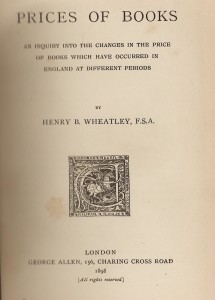 H.B.Wheatley’s Prices of Books (1898) is a real eye opener, not just for the prices realised by truly great and important books, but also for those works which today would not fetch ( in real terms) anything like the sums that our Victorian forebears might have paid.