The Cavern – a view from 1964

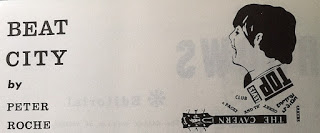
Found in Arrows 87 (Summer 1964, edited by Roger Ebbatson) this amusing piece about 'Beat Music.' The magazine was produced by Sheffield University Union and had poems articles, graphics etc., This article was by Peter Roche a poet who was affiliated with the Liverpool Scene. He edited a 1960s anthology Love, Love, Love (The New Love Poetry) and is to be found in various poetry collections and anthologies. He was also a friend of John Peel and Cream lyricist Pete Brown.The article shows how, at the time, The Cavern (the club where the Beatles played and were discovered) was not universally loved...

Beat City by Peter Roche

Let me tell you all  a fairy story. Once upon a time, in a  city far away across the hills to the west, there was an old warehouse, in an alley off a side street. And underneath this warehouse was a cellar, where the local groups used to play their music far into the night. And people who lived on the banks of the river used to go to this cellar, because it was somewhere to go when the pubs had kicked out and you were half cut and there was nowhere else to go, and anyway there was a fair old chance of picking up a judy there. And everyone was fairly happy, minding their own business and having the occasional punch-up.

Continue reading

Son of the Sixties

Found - in Axle, a short lived magazine, from June 1963 this amusing and intriguing portrait of a sixties type (or archetype.) It was written  by Ken Howard and Alan Blaikley the editors of the magazine. These 2 men, 23 at the time, went on to become successful pop music composers - hits included Dave Dee's Xanadu..In 1970 they even wrote a song for Elvis ('I've lost you'.)The reference to 'Dexadrin' is obscure- can find no trace of such a magazine, possibly ingested rather than read...

Son of the Sixties

Build: Tall; slim; muscular without exercise. Complexion: clear; permanently bronzed without sun or Man-tan; never sweats...Seldom laughs (but rare smiles are planned and dazzling - he was born in natural fluoride area). Hair: Black; well-combed, no dressing; styling suggests but never quite descends to more obvious fashions of the day (Frost, Como, etc.) Clothes: by John Michael and Marks and Spencer. Can wear white shirt for whole week. General appearance: Air of masculine competence cunningly offset by one or two ambiguous touches (name-bracelet, St. Christopher chain, pastel denim shirt); usual expression, mixture of Come-Hither and Come-Off-It; can appear alternately boyish and authoritative, a trump combination arousing maternal and subject feelings in women simultaneously, rendering him irresistible. Looks at best after all night party. Background: only son of fashionably separated parents (White Russian mother, Franco-Jewish father) whom he visited alternately in school holidays; discreet fostering of their sense of guilt won him ample allowance and Porsche at 18. Education: Attended Bedales where he swam on summer nights in nude and was encouraged extracurricular activities; he in turn encouraged extra martial activity of master's wife who fondly imagined she had done the seducing. Always the centre of any group, without responsibility of actual leadership...Scraped 3 G.C.E. passes and entered St. Martin's Art School where... he gained undistinguished diploma. Occupations: rejected father's suggestion that he should 'work his way up from the bottom' (in three years) in his costume jewellery business. After spell as bar steward on Azores run where he cut dashing figure in whites, found (with friend of girl friend's help) tailor-made niche as London P.R.O. for obscure but loaded mining venture in Pretoria which enables him to indulge twin ambitions of luxurious living and complete independence. Residence: From liberal expense account was able to set up basement flat in renovated Earls Court terrace, where he frequently throws lavish (but informal) parties that are unexceptionally tremendous successes and are usually raided. (But he has a way with The Law). Clubs: Discotheque, Le Gigolo, Muriel's National Film Theatre, La Poubellle, Rockingham, Ronnie Scott's (offer drinks at, but has never joined The Establishment). Takes: The Observer, Peace News, Dexadrin. Glances at: The Times, Daily Express, Izvetzia, Private Eye, Encounter, Town, Playboy, Paris-Match, Sight and Sound, his horoscope. Went through novel and poetry reading stage at 15; still studies reviews quite carefully. Listens to: Today (2nd edition), Pick of the Pops. Watches: Panorama, Tonight, Compact (for laughs and because he knows some of the cast very intimately), Points of View. Outlook: Intellectual inferiors regard him as unassumingly highbrow, while academics find his 'untouched originality' refreshing. Remarkably adaptable, is equally at home in company of Soho villains and company directors, pop singers and clergymen. Mixes everything from sex to drinks and generally likes neither straight. Believes in experience (hash-smoking, etc.) as a right rather than as anything wildly off-beat, but demands best in everything. A self-confessed dilettante, seeks to avoid type-casting; likes to confound admirers of both sexes by appearing in public with wholly atypical companions. An agnostic, takes pleasure in arguing case for Christianity and was cynical at attempts at compromise in Honest to God. Politics: Wouldn't vote in next election even if he were 21. Occasionally supports Committee of 100 demonstrations, but no longer marches ... Future: Middle-age. And then…?
(Excerpt)

Leon Gambetta’s crisis

Leon Gambetta—‘ the grand orateur et homme d’Etat’.

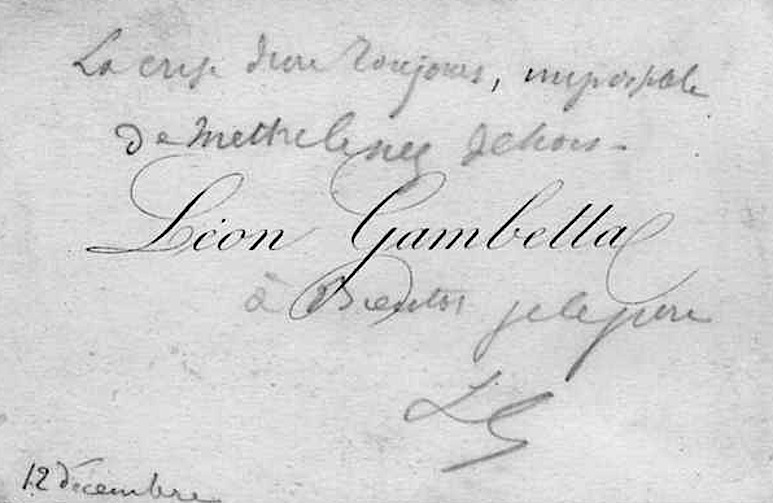
So reads the printed label stuck on the back of this carte de visite by a French dealer sometime early in the twentieth century. It is indeed a ‘ curieuse piece ‘, as the dealer avers. Gambetta has addressed in pencil, above his printed name, the following remark to an unidentified friend or colleague:

‘Le crise dures toujours, impossible de mettre le nez dehors…’
(The crisis is lasting for ages, impossible to stick ones nose outside…)

Historians might debate what crisis Gambetta is referring to. There were doubtless several in the tempestuous political career of one of France’s greatest heroes. But the date of 12th December that Gambetta adds at the end of his message might offer a clue. In Paris from 23rd November to 15th December 1877 the improbably named President McMahon presided over a ministry that excluded all ‘parliamentary hands‘ like Gambetta and his democratic colleagues. During this period it was felt that MacMahon was planning a coup d’etat and this crisis came to a head around December 10th and 11th. The idea was to deny power to Gambetta, who may have felt that his life was in danger during this time. Excluding Gambetta worked for a few years, but eventually, in 1881, he was asked to form a ministry. This lasted for just 66 days.

Around late November 1882 Gambetta was shot in the stomach, but this was an accident. However, it may have contributed to the stomach cancer that eventually claimed his life, on 31st December 1882.

[R.R.]  

Donald Davie & the poetry scene (1963)

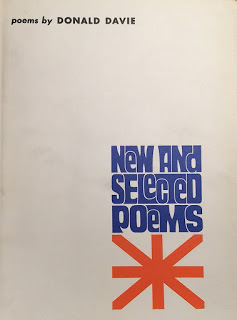
Found in a copy of New & Selected Poems by Donald Davie (Wesleyan University Press, 1961) a handwritten letter from the author. A good newsy letter that gives a snapshot of the  Oxford and transatlantic poetry scene of the early 1960s. It is to Fred Hunter founder of Independent Radio News, teacher of journalism and something of a poetaster and friend of many of the Sixties and Liverpool poets. He also had a poetry record label (Stream Records) which in 1967 put out an L.P. of the American poet Dorn reading from his North Atlantic Turbine. The letter reads:

[Gonville and Caius College, Cambridge]. June 18th 1963.

Dear Mr. Hunter,

I was touched and pleased to have your request from yourself and Mr. S. Raut Roy. I have today dispatched the books to you - don't send them on to India before taking out your own two copies!

I know Jonathan William, by name of course and I believe he was lately entertained by my young colleague Jeremy Prynne, to whom I am chiefly indebted for my knowledge of the Projective Verse poets, who seem to me to represent the only plausible growing-point for Anglo-American poetry. Olson I esteem chiefly as a theorist, Duncan's work I hardly know, but Creeley's I admire very much. We would link with him Edward Dorn whose very distinguished collection in typescript we are at present (Prynne and I) trying to place with a London publisher - but with predictably little success. 

I am having great difficulty about completing a new collection of poems which will represent in some degree the sympathy I feel for some of the Projective Verse methods. But this business of doubling up as poet and don is quite hopeless! 

Again, I'm grateful.

Yours sincerely, 
Donald Davie

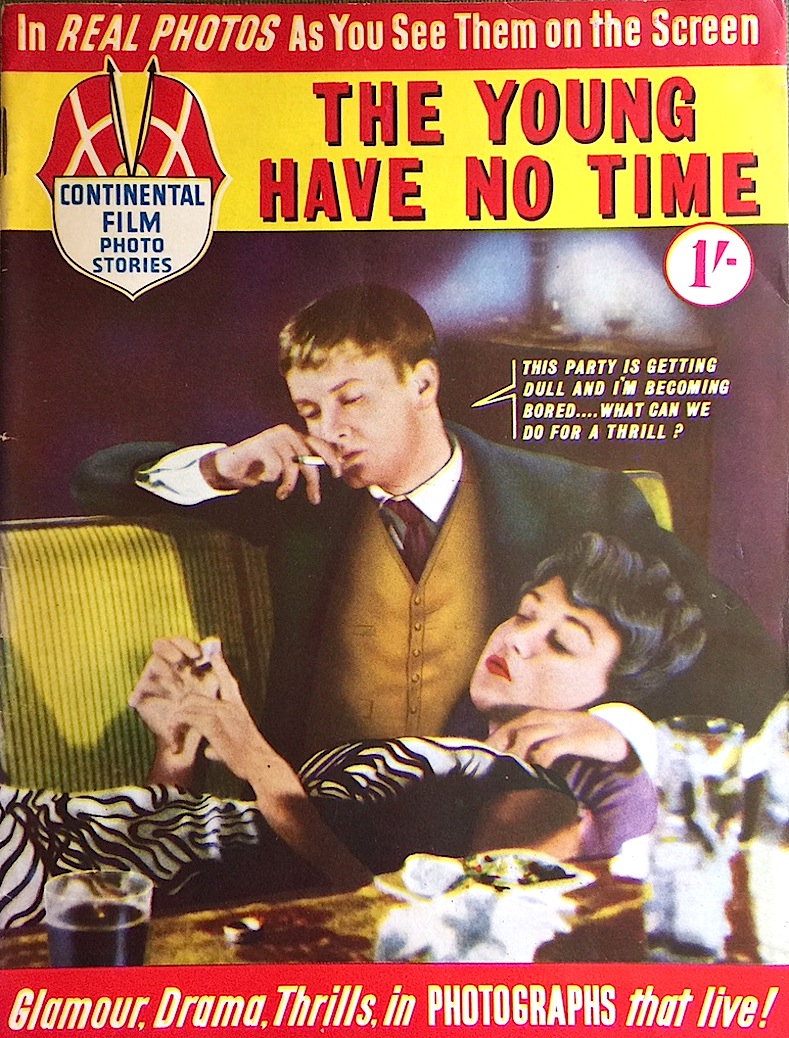
‘The Young Have No Time’ – a fumetti (1960)

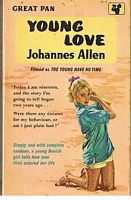
Fumetti is an Italian word (literally 'little puffs of smoke' in reference to speech balloons) which refers to all comics. In English, the term often signifies photonovels or photographic comics, a genre of comics illustrated with photographs rather than drawings. These were often taken from movies or television. Photonovels were  popular on the continent, especially in Italy and further afield in Mexico. They had a life in England, especially in romantic stories for young girls. This photo novel which appears to be from 1960 was in a series designated 'Continental Film Photo Stories.' It is taken from the Danish movie Ung Leg a tale of wealthy/ elite youth in post war Copenhagen. While promising (from the cover) a sort of Leopold and Loeb plot of senseless/ existential murder it does not get more daring than a game of 'chicken' on a railway line. A Pan paperback film tie-in novel by Johannes Allen, Young Love, appeared in 1966. The film The Young Have No Time was also directed by Johannes Allen.

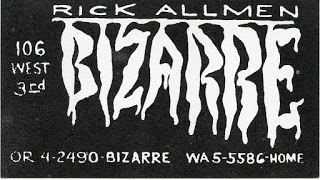
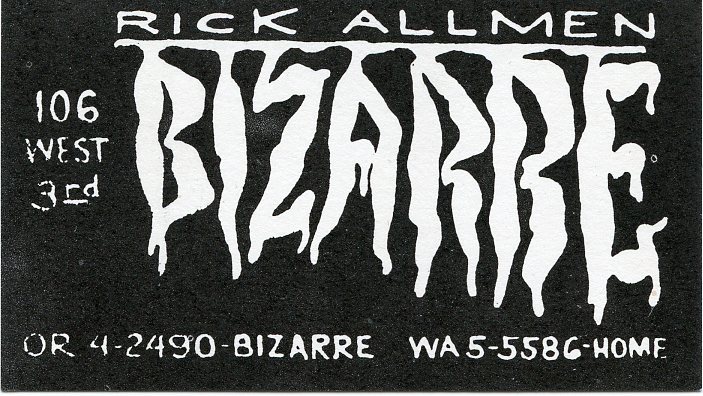
Cafe Bizarre – Beatnik club

Found- a rare piece of Beatnik ephemera, a card from New York's Cafe Bizarre with the phone numbers and name of Rick Allmen who started the club in 1957. The Cafe Bizarre was one of the better known clubs to capitalise on the beatnik phenomenon, and the venue for many counterculture poets and musicians of the period. Musitron Records even recorded an album of Beat festivities at Cafe Bizarre in the late '50s. (In the post-beatnik-era Andy Warhol discovered The Velvet Underground there.) Another band who played there was the Lovin' Spoonful who described the place as a 'little dump' (1965 -post its Beatnik Glory).They played 3 gigs a night and were paid with tuna fish sandwiches, ice cream and occasionally peanut butter and jelly sandwiches. More can be found at Rock and Roll Roadmaps.

The Secret Places XXI & XXII

The last two chapters of The Secret Places (Elkin Mathews & Marrot London 1929) - a chronicle of the 'pilgrimages' of the author, Reginald Francis Foster (1896-1975), and his friend 'Longshanks' idly rambling in Sussex, Kent and Surrey. See our posting of the first chapters for more on Foster and this book, including a contemporary review in The Tablet.

Continue reading

A voyage to Russia in 1908 & 1965 (2)

Nevsky Prospect Leningrad 1960s
(thanks Transpress N.Z.)
This is the second part of an anonymous diary found in our archives (see part one.) It was written first by a young woman of about 20 in 1908. Here she returns in her mid 70s (by plane.) Leningrad has since become St. Petersburg and the Astoria has become very expensive...

Sunday 12th September, 1965

 Perfect flight from London taking less than seven hours including half-an-hour at Copenhagen. Wonderful cloud effects. We spent ages waiting at the Leningrad customs. On reaching the hotel Astoria unpacked and changed. We had an excellent luncheon at 1 o'clock; sprats, not unlike sardines, Chicken Kiev. Separate course of peas, (not very good) grapes. A white wine and a red wine. The latter good, the white not interesting.

 In the afternoon we went to St.lsaac's Cathedral, a monster of vulgarity - everything gilt or malachite, except two elegant columns of lapis and a wooden model of the cathedral; these were the only things that pleased me.
We had a good dinner, but oh, the slowness of the service! We went to bed early.

Continue reading

A voyage to Russia in 1908 & 1965 (1)

Found- an anonymous account of a a trip to Russia on The Salsette in 1908 written by a young woman of an artistic bent. There is a certain amount about the ship, mostly at Shona's Wrecks (many thanks) which mention this voyage to Northern European cities, the Salsette's first major outing. In 1915 the ship was hit by a torpedo and lies 600 feet down off Portland Bill, now a favourite wreck for divers to explore.In 1965, probably by then in her mid 70's, our diarist flew back to Russia and remarks on the changes (to follow).

ON BOARD “THE SALSETTE”

20th August, 1908

  It has been rather rough and cold all day but for all that I have greatly enjoyed it. I was so tired after last night that I slept on till past 9 o'clock this morning, and then had breakfast in bed. All the competitions have started again, and out of the two I have played to-day I have again won one. It has been very nice and restful having another whole day at sea - one gets so frightfully tired sightseeing. Every town we have been to see so far has been paved with cobble stones, roads and pavements alike, and this, especially when one has thin soles to one's shoes, very quickly makes one's feet ache.

Continue reading

Famous people from Stevenage (2) Edward Gordon Craig

The only other one appears to be the racing driver Lewis Hamilton, who was really born in Tewin, a few miles away, though some sites will tell you differently. According to the site devoted entirely to famous Stevenage people, most of the other contenders are bit players on soap operas or models, although it is not specified that the one decent footballer amongst them, Manchester United’s Ashley Young, actually came from the town.

Anyway, it can truly be said that Edward Gordon Craig (1872 – 1966), the eminent man of the theatre, designer of stage sets etcetera, was indeed born in Stevenage, long before the ancient Georgian coaching town had a bright, spanking New Town tacked onto its southern end. The illegitimate son of the famous actress Ellen Terry and architect Edward Godwin, it was almost inevitable that he would make his name as a stage designer, with his radical ideas of neutral non-representational sets and use of top-lighting. This photo (to follow) comes from the same archive of press photos featuring Herbert Read, Stephen Spender, Harold Nicholson and Desmond MacCarthy that inspired previous Jots– so one must assume that it too belongs to the Sunday Times Book Exhibition of 1936.

One extraordinary fact about Craig is that although he lived to be 94, all his most significant work was done before the age of 40—that is, before 1912. [RR]

Benjamin Jowett—‘I am Master ‘

"Here come I, my name is Jowett
  All there is to know, I know it
  I am Master of this College
  And what I don’t know isn’t knowledge."

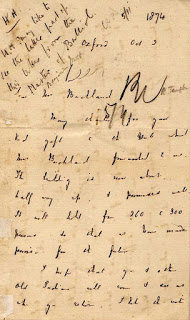
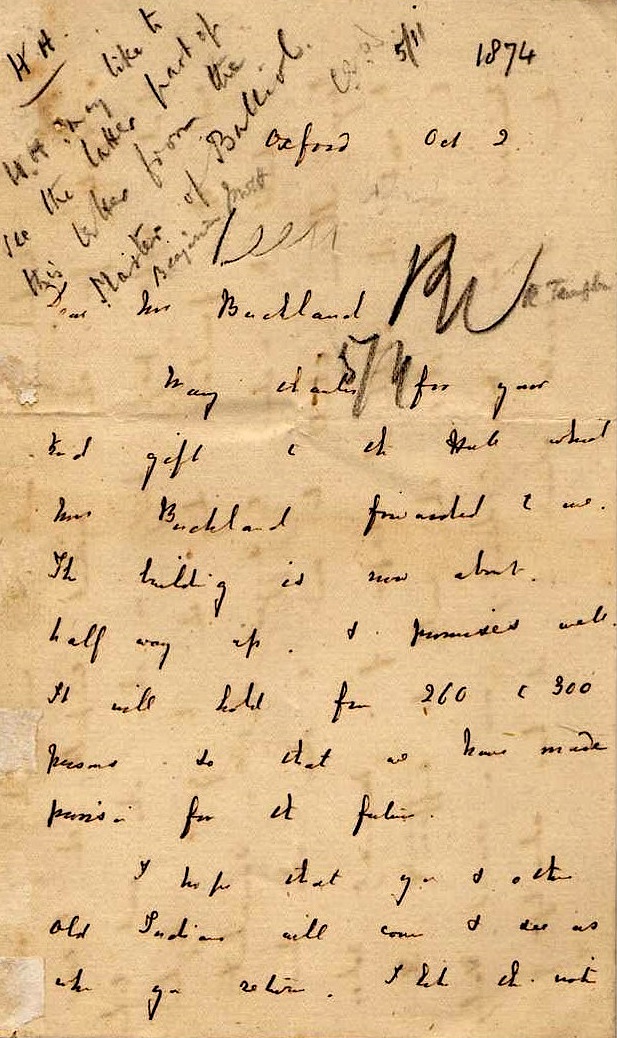
This squib gently mocks the pretensions of arguably Balliol College’s most famous Master. Jowett was a Greek scholar, and like many classicists through the ages, felt that a grounding in Latin and Greek was sufficient qualification to tackle most areas of knowledge. But he was also a dedicated theologian and an educational reformer. This letter, which another hand (possibly the same one that snipped out Jowett’s signature, thus losing text) has dated in pencil 5th November 1874, four years after Jowett was appointed Master, is addressed to a Mr Buckland (possibly a member of the celebrated clan of eccentric scientists). In it Jowett, who was always interested in Indian affairs and was a member of the 1854 committee drawn up to debate the future administration of the colony, shows his keenness to promote the benefits of an education at Oxford University to young men who might wish to join the Indian Civil Service. Previous to 1858, when it closed, such candidates would have been trained at Haileybury College, near Hertford, but Jowett argues that an Oxford education might prove more attractive to these young men than a stint at Haileybury, should that institution be ‘revived’.

Continue reading

The Secret Places XIX & XX

The penultimate two chapters of The Secret Places (Elkin Mathews & Marrot London 1929) - a chronicle of the 'pilgrimages' of the author, Reginald Francis Foster (1896-1975), and his friend 'Longshanks' idly rambling in Sussex, Kent and Surrey. See our posting of the first chapters for more on Foster and this book, including a contemporary review in
The Tablet.

XIX

OLD CRACKPOT

All day we had laboured southwards into the Kentish Weald, our clothing plastered in front with the sleet that drove upon us and our boots squelching at every step. In many miles we had not spoken. Longshanks sucked dismally at an inverted pipe which had long since grown cold.
In the end of such journeyings is a deeper content than of those made in fair weather. When the light failed over the eastward hills and the shifting wind brought a greater cold, we came upon a barn, and entered it as men who come to their last rest. As we heaved the door into place the day died over Sussex.
Continue reading

The ‘Belfast of Canada’

Anyone with even slight Catholic sympathies would probably not have got on well in Toronto during the late nineteenth century, when it had become a hotbed of Protestant ascendancy. By the turn of the century, the power of the Orange Order, who returned twenty of the twenty three mayors in fifty years, got it nicknamed 'the Belfast of Canada'.
Even by the 1940s this legacy had not waned sufficiently for the artist and writer Wyndham Lewis who, forced by circumstances to spend several years there during the War, was constantly frustrated and angered by the philistinism and religious bigotry of its leading lights.

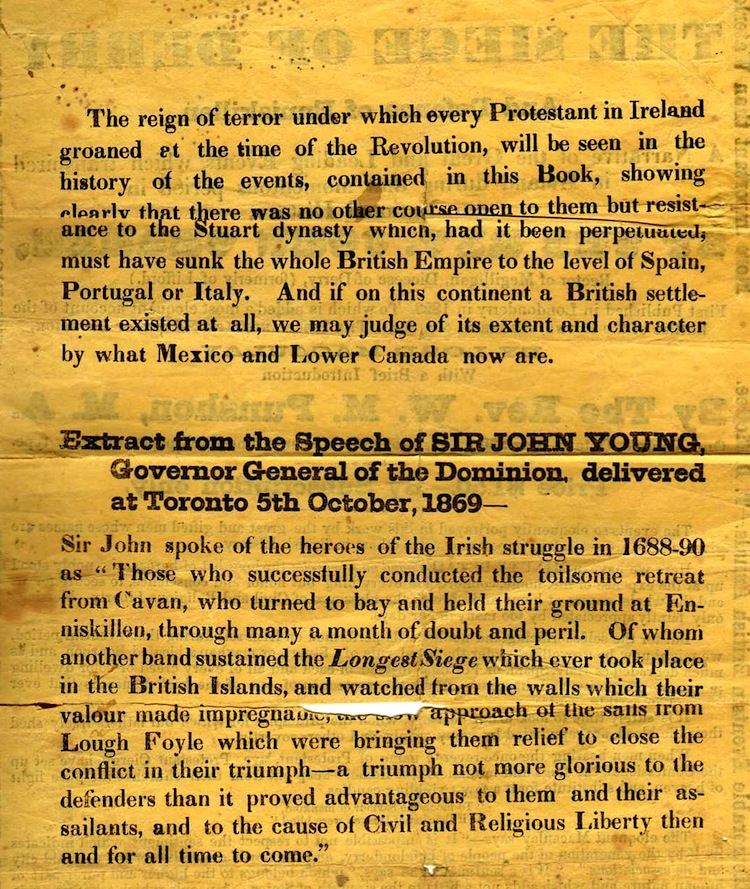
The prevalence of militant Protestantism in mid nineteenth century Toronto is well illustrated by this scarce flier of c 1869 from Maclear and Co, the dominant publisher in Canada for many years. In advertising the forthcoming reprint of The Siege of Derry, originally published in 1823 by  the Rev John Graham, a clergyman from Ulster , it combined blatant propaganda on behalf of ‘ the heroes of the Irish struggle in 1688 – 90 with a nifty aside aimed at backsliding Anglo-Catholics:

'When men bearing the once-revered name of Protestant , aye Protestant clergy, have set up the Confessional, the Rags and mummeries of Rome…'

A rather appropriate piece of propaganda, given the crisis now attending the power-sharing agreement at Stormont.

R.M.Healey

Famous people from Swindon Number 3: Alfred Williams

Two other contenders could be Diana Dors (nee Fluck ) and Desmond 'Human Zoo' Morris. This letter, from a perhaps less famous Swindonian (though he actually came from South Marston) was rescued from a junk stall on the Portobello Road a few years ago. It was written by Alfred Williams (1877 – 1930), sometimes known as the ‘Hammerman Poet ‘, because for 23 years he worked for the GWR, latterly  operating  a steam hammer—a task that severely damaged his health.

Williams, who published several volumes of decent verse and topographical writing as well as the much admired Life in a Railway Factory, belongs to that small category of writers (most of them poets) who held boring and/or physically taxing jobs while creating reputations for themselves in the literary world. The best known was probably John Clare, but a more recent example is the celebrated poet Peter Reading, who had the thankless task of operating a weighbridge. After many years of doing this he famously refused point blank to wear a uniform when it was imposed on him and instead resigned, whereupon his admirers in the literary world came to his rescue with offers of more congenial literary work.

Continue reading

An Address to the people of Suffolk on incendiary fires

Found in the Haining collection - a mid 19th century pamphlet An Address to the people of Suffolk on incendiary fires. No publisher, author, date or place of publication is given. WorldCat notes that there is a copy in the Goldsmiths'-Kress Library of Economic Literature, (no. 34328) and says the author was probably  Lord Thurlow - a Suffolk peer (Edward Hovell-Thurlow) and estimates a publication date of 1845. Evidently Suffolk was plagued by arson at this time. An impassioned plea, unashamedly patrician in tone, to stop this outbreak. It appears to be addressed mainly to farm workers and may have been spoken to a gathering and/or published in local newspapers. The account of the violent and seditious behaviour of people at the fires is fascinating and alarming...

Continue reading

A rare souvenir of London’s Great Wheel

The Great Wheel, which was built for the Empire of India exhibition at Earl’s Court in 1895, and was the ‘London Eye’ of its time, is pretty well documented. Postcards showing various aspects of it can be had quite easily, as can medallions, which were struck periodically throughout its career, right up to 1907, when it was demolished. But what we have here is something quite rare—on a number of levels. Firstly, it is a large photographic image of the wheel—four times the size of a postcard—which was mounted on board and sold –presumably to be framed and hung—by the famous  commercial printers of posters, stamps and banknotes, Waterlow and Sons Ltd. And there on the lower right hand corner is the signature of the Wheel’s ‘constructor ‘ Walter B Basset ‘, which may be original, but could equally be a facsimile. Lastly, we can date the photograph because it depicts the Wheel looming above the temporary constructions in painted wood and ironwork—some especially imported from India-- that comprised the Exhibition, which was the brainchild of Imre Kiralfy, a producer of burlesques and spectacles.
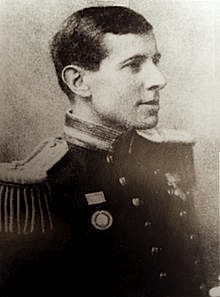
Interestingly, in the background can be glimpsed  the warehouses that stored the forage for the horses that transported goods of London largest department store, Whiteleys, while in the bottom left hand foreground can be seen a very early example of an elaborate electric floodlighting system for the Exhibition. If the signature is a facsimile then this mounted photograph could well have been a bit of opportunistic merchandising by Basset, who remains a very significant figure in the history of the amusement industry. Born Walter Basset Williams in 1864, the scion of an ancient Devon family, whose seat was Watermouth Castle, he entered the Royal Navy but left in 1882, possibly due to ill health, and instead took up engineering with the well established Maudslay Sons and Field, which specialised in steam-power. Here he did well and by the age of just 27 had become managing director. In 1894, inspired by the pioneering example in Chicago, he begun to build his first steam-powered Ferris Wheel at Earl’s Court, which when completed stood 300 feet high and contained 30 carriages, each of which could carry 30 passengers. It was an immediate success, but its popularity waned over the following years and in 1907 it was dismantled and the metal sold for scrap to the same company which 46 years later was to buy the Skylon at the Festival of Britain and produce cigarette cases from the scrap metal.

While the Wheel was still operating, however, Basset built other Ferris Wheels at Blackpool and Paris, but neither were a financial success, and when Maudslay went bankrupt in 1899, he set up his own business, The Basset Nut and Screw Company, in Belgium. In the end the destruction of his prized project at Earl’s Court may have been the last straw for a man in poor health, for in May 1907 he died, aged just 43, at the family home in Devon.  Thankfully, the Vienna Riesenrad survived its creator and is now one of the city’s greatest attractions—it featured in the films ‘The Third Man’ and ‘The Living Daylights’.

[R.M.Healey]

Gunmen in Piccadilly (Edgar Wallace)

Found in the Haining archives - this slightly scaremongering article by Edgar Wallace from Nash's Pall Mall Magazine in March 1931. Edgar Wallace (1875-1932) was the adopted son of a Billingsgate fish porter in London, and largely self-educated - the newspaper boy who became one of the most famous writers in the world. He sold millions of books, but he was plagued by debts due to an extravagant lifestyle. He left Britain for the United States in 1931, only to die in Hollywood in 1932, aged 56, after writing the original story for King Kong. His body was returned by ocean liner in honour, only to be reunited with an ocean of outstanding bills.It is said all his debts were paid off in a few years from massive book sales. This article was copyrighted from America and one can imagine him churning it out in Hollywood to pay the bills. The title belies the content which is about criminal gangs anywhere in Britain- even art thieves. A BBC radio programme earlier this year by thriller writer Mark Billingham on Edgar Wallace (The Man Who Wrote Too Much?) suggested he was somewhat forgotten. He may not be much read anymore but his books are still collected throughout the world…

Continue reading

The Secret Places XVII & XVIII

Two more chapters of The Secret Places (Elkin Mathews & Marrot London 1929) - a chronicle of the 'pilgrimages' of the author, Reginald Francis Foster (1896-1975), and his friend 'Longshanks' idly rambling in Sussex, Kent and Surrey. See our posting of the first chapters for more on Foster and this book, including a contemporary review in The Tablet.

Continue reading

Harold Nicholson and Desmond McCarthy—the terrible twosome

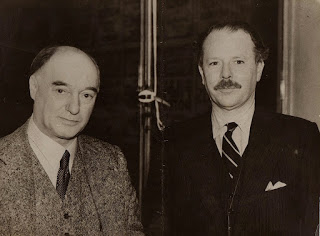
Maybe I haven’t looked hard enough, but the only photos I’ve seen that feature Harold and Desmond have also included other Bloomsberries, notably Vita Sackville West. I’m not a fan of Bloomsbury and could only bear to watch ten minutes of one episode of the current TV drama, Living in Squares, but I don’t think either man was part of the Virginia 'n Duncan inner circle, as it were, and I don’t think the two were great friends. But there must be some reason why they were snapped together. Perhaps it was another bookfest organised by the Times or Sunday Times, as was the case with the Read and Spender press photo. This one, from the Graphic Photo Union,  bears identifications in pencil on the reverse . Desmond died in 1952, aged 75, a year after being knighted for services to the critical essay and the amusing anecdote, so the photo was probably taken around the mid 1930s.

Some of the most entertaining and scathing remarks on MacCarthy and Nicholson can be found in Virginia Woolf’s published Diaries. I have the volume for 1931 – 36. Here, for instance, are her views on Desmond:

Thursday, 3rd September 1931
‘…Oh, I was annoyed at Desmond’s usual sneer at Mrs Dalloway---woolgathering. I was inspired to make up several phrases about Desmond’s own processes, none of which, I suppose, will ever be fired off in print. His worldliness, urbanity, decorum as a writer; his soft supple ways. His audience of teaparty ladies & gentlemen. His timidity. How he wraps everything in flannel…His perpetual condescension.His now permanent stoop in the back. His aloofness---in the bad sense. I mean, he never takes a nettle by the leaves: always wears gloves…’

And Nicholson:

August 12, 1934
‘…Vita thinks Harold is getting soft & domestic, because he talks of grandchildren & wants to have a butler to brush his clothes & a spare room…’

[R.M.]

A begging letter from a debtor’s prison

Begging letters from debtors don’t usually survive, although there are at least three reasons why they might. Perhaps the writer was a well known person who at the time was down on his luck and counted on a friend or person of means to help him out. Alternatively, the writer could later have become famous or even notorious and the letter would be regarded as a souvenir or talking point. Of course, the writer could have been neither famous nor notorious, and the retention of a begging letter was a means of recording a favour that one man owed to another.

This particular letter is from someone who signs himself M. Eurius Beaubrier, and is addressed to a Henry Clarke. Although preliminary research has revealed nothing of the writer, who may have been French, the handwriting is that of an educated man and the tone is rather pathetic. The letter suggests that both he and Clarke, who is also hard to identify, had dealings before.

Continue reading